

 English

Sanitary IBC Tote for Pharmaceutical Liquid: Specs, Drainage and Cleaning
A 1,000 L stainless steel IBC that drains to a 0.3 percent heel still carries close to 3 litres of product on its walls, inside the outlet elbow and under the baffle. When the product is a filtered pharmaceutical liquid, those 3 litres are not only lost yield; they are the residue that decides whether the next batch starts clean.
Sanitary IBC selection usually goes wrong in the details rather than in the headline: wetted finish, drain geometry, connection type and the paperwork trail behind the steel. This guide covers what quality teams and inspectors actually examine, and how to write a specification that survives the build.
Working rule: if you cannot see the whole dished bottom through the manway and reach the outlet with the spray ball pattern, cleaning validation will be written around a weak point instead of a design.
What Counts as a Sanitary IBC Tote for Pharmaceutical Liquid
A sanitary IBC tote for pharmaceutical liquid is a transportable stainless steel vessel whose wetted surfaces are 316L, internally finished to a controlled roughness, fully drainable at the outlet, and fitted with hygienic connections and documented gaskets so that it can be cleaned and rinsed in place between batches.
Sanitary design in one sentence: no dead leg, no threaded product contact, no flat floor the liquid cannot leave, and no surface the cleaning agent cannot reach.
Four features separate a hygienic tote from a food-grade one, and each of them can be checked on a drawing before the vessel exists:
- Product contact in 316L stainless, exterior in 304, with all welds ground and passivated after fabrication.
- Radiused internal corners and a dished or sloped base so the last litre reaches the outlet without pooling.
- Tri-clamp or aseptic flange connections, with threaded sockets, cavity-type ball valves and compression fittings designed out.
- A spray ball on the top plate, a hydrophobic vent filter port, and a manway wide enough for inspection and manual cleaning where required.
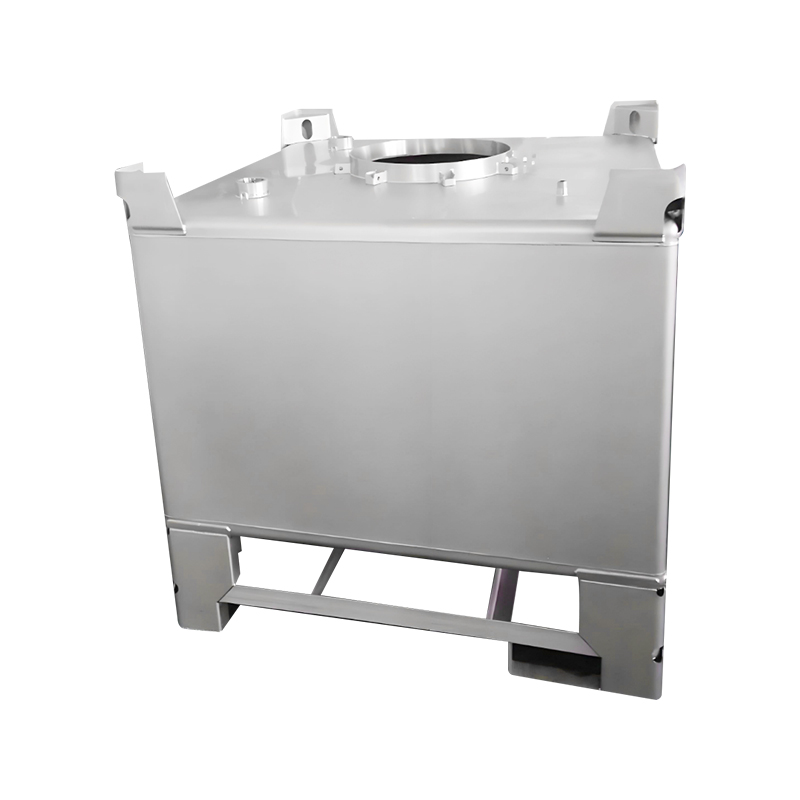 Stainless Steel IBC Tanks for Hygienic Liquid StorageSUS304/SUS316L IBC tanks with polished welded bodies and custom fittings, suited to validated cleaning, solvent compatibility and pressure transfer.View Product →
Stainless Steel and HDPE Composite Totes Are Not Interchangeable
A stainless steel IBC is the correct choice over a composite HDPE tote whenever the liquid needs validated cleaning, solvent compatibility, hot cleaning cycles or pressure transfer; the composite tote still wins on cost per litre stored and on one-way logistics.
| Criterion | Stainless steel IBC | HDPE composite IBC |
| Product contact | 316L sheet with controlled internal roughness | Blow moulded polymer body inside a steel cage |
| Extractables data | Metal surface, well characterised and stable | Polymer dependent, requires vendor documentation |
| Cleaning validation | Repeatable CIP with spray ball and verified rinse | Often dedicated or single-trip, harder to verify visually |
| Temperature | Handles hot cleaning solutions and steam cycles | Limited by the polymer and the cage fittings |
| Pressure and vacuum | Can be designed for pressure transfer | Generally atmospheric only |
| Service life | Refurbishable, with re-passivation over time | Limited by permeation and stress cracking |
The decision is rarely about the tank. It is about whether your cleaning validation can be repeated on the same vessel fifty times without opening a new worst case.
Six Points That Decide the Build Specification
Most specification mismatches on a pharmaceutical IBC come from six fields, and every one of them can be written unambiguously before the first sheet is cut.
- Working volume and fill level. State the working volume rather than the gross volume, and confirm whether a 1,000 L rating means brim-full or an 80 percent fill.
- Alloy and finish. Specify 316L for wetted parts, the internal roughness value with its measurement method, and whether passivation or electropolishing is required after welding.
- Drain geometry. Ask for the outlet to sit flush with the lowest point of the dished base, with the valve facing the operator side and no horizontal run ahead of it.
- Connections. Fix tri-clamp sizes for inlet, outlet, vent and spray ball, and confirm the vent filter thread separately, because it is the connection most often left to the supplier.
- Handling. Forklift pockets, lifting lugs, stacking frames and corner protection must match how the tote travels between dispensary, corridor and loading bay.
- Documentation. Agree material certificates, roughness report, pressure test record and surface treatment record at purchase order stage, not after delivery.
Give the drain point in millimetres from the base. "Lowest point" is interpreted differently by every fabricator, and the gap between interpretations is usually 10 to 20 mm of standing liquid.
Cleaning, Drainability and Cross-Contamination Control
Cross-contamination in a tote rarely comes from the barrel wall; it comes from the outlet assembly, the gasket groove, the vent path and any horizontal surface the rinse water cannot leave.
Three areas absorb most of the cleaning effort:
- Rinse path. Confirm the spray ball wets the top plate, manway ring and valve body, not just the barrel wall.
- Gasket grooves. Use a gasket that lifts out without a tool, and replace it on a fixed interval rather than on failure.
- Vent and transfer line. The vent filter housing and the discharge hose sit inside the cleaning boundary, so write them into the rinse sequence.
A widely used acceptance target is a heel of no more than 0.3 percent by weight, roughly 3 litres in a 1,000 L tote. If the outlet cannot beat that on a water drain study, no amount of spray ball tuning will recover the difference.
Where the Tote Sits in a Pharmaceutical Liquid Train
The tote is a holding and transfer vessel, not a filter, so its real performance depends on what runs before and after it; placing it correctly cuts both particle load and cleaning frequency.
Before the tote
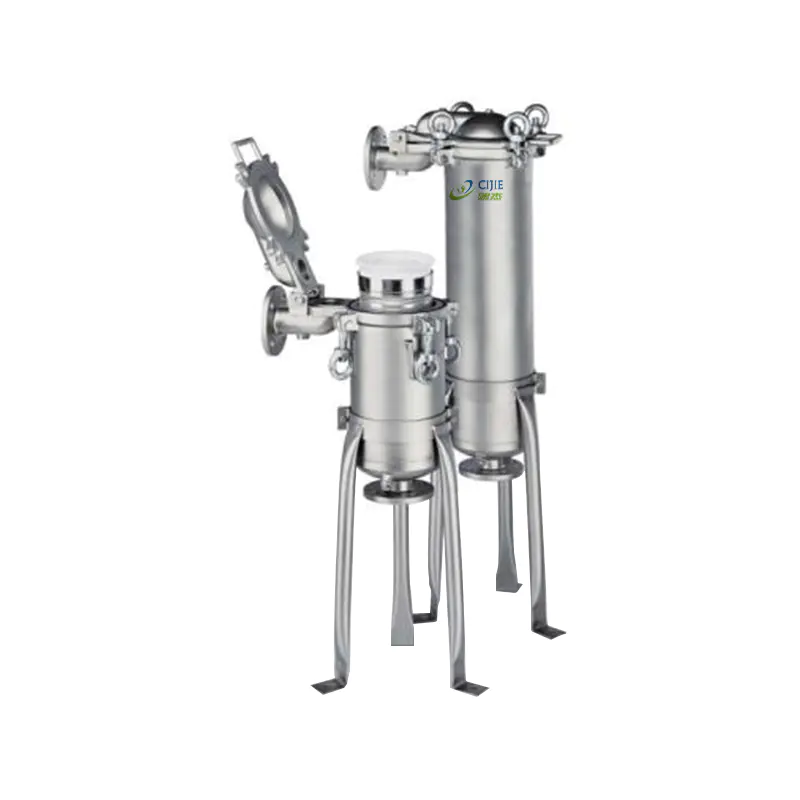
Bag or cartridge filtration removes bulk particulate before the liquid enters the vessel. Taking solids out early keeps the walls cleaner and reduces the rinse volume needed between batches.
After the tote
A final polish filter at 0.2 micron, placed after the tote and just before filling, captures anything shed by the valve, the vent or the transfer line at the last possible point.
A tote filled through a filtered line and emptied through an unfiltered hose is a filter bypass with a stainless shell around it.
The chemical and pharmaceutical industry applications overview shows how bag filters, cartridge housings and candle filters are typically arranged around holding vessels in these processes.
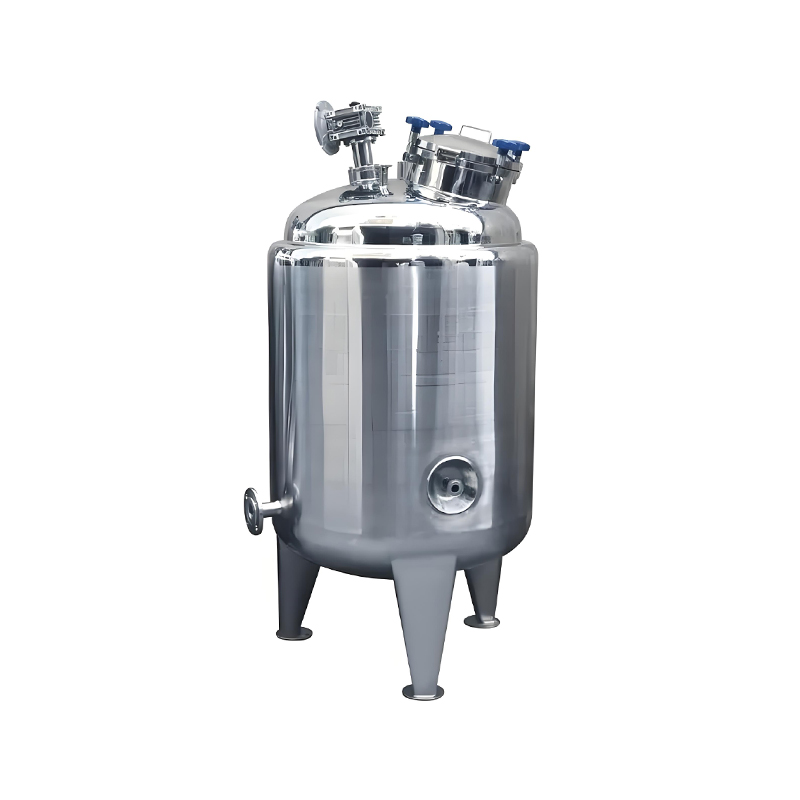 Sanitary Stainless Steel Storage Tanks for Hygienic Process LiquidsSUS304/SUS316L vessels with mirror-polished interiors and CIP ports, supplied with material certificates and inspection records for pharmaceutical, food and chemical storage.View Product →
Documentation and Quality Control Before Delivery
Ask for the quality file with the quotation rather than with the shipment, because on sanitary vessels the documents are usually harder to retrofit than the steel itself.
The in-process inspection sequence used during fabrication is a practical template: weld examination, dimensional checks and finish verification before the vessel leaves the shop floor.
If a supplier cannot produce a roughness report with marked test points, treat the quoted finish as a claim rather than a specification, and price the verification work into your own incoming inspection.
Frequently Asked Questions
Can one sanitary IBC tote handle several different pharmaceutical liquids?
Yes, provided the vessel has a written cleaning procedure validated against the worst case of the product families involved, including the least soluble and the most potent. Residue limits, rinse volume and gasket changeover should be defined per product group, not per batch.
What internal surface finish should be specified?
Ra 0.8 micron is the common baseline for pharmaceutical liquids, while 0.4 micron is requested for potent APIs or where residue must be measured at low levels. Specify the measurement instrument and the number of test points as well, otherwise the number cannot be verified on receipt.
Does the tote need to be pressure rated?
Only if you transfer by pressure or pull vacuum during filling. If the vessel stays atmospheric, state that clearly and specify the vent filter instead, then confirm the design and test pressure in writing so nobody assumes a rating the shell does not have.
How long does a stainless IBC last in pharmaceutical service?
With periodic re-passivation and scheduled gasket replacement, the vessel body can serve for many years; the parts that end its life are usually crevice corrosion at poorly finished welds and chloride attack from cleaning agents left in contact too long.

Copyright © RUGAO CIJIE ENVIRONMENTAL TECHNOLOGY CO., LTD. All Rights Reserved. Industrial Filtration Equipment Factory Filtration Equipment Manufacturer
